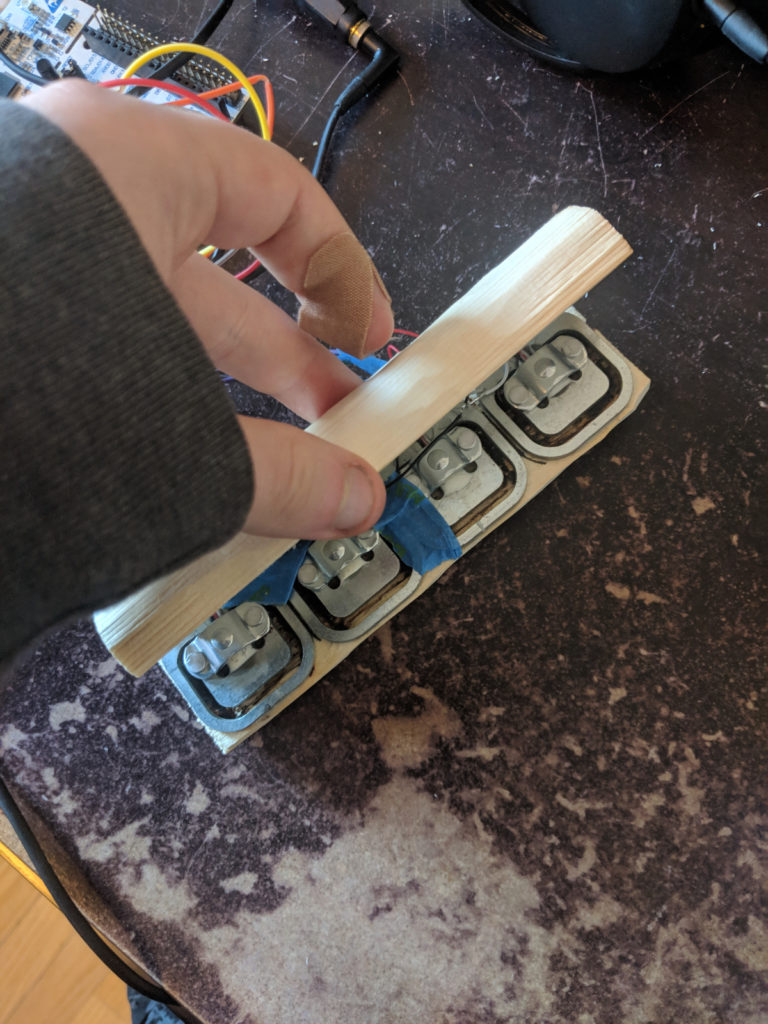
I carved handles out of wood and mounted the strain sensors in it.
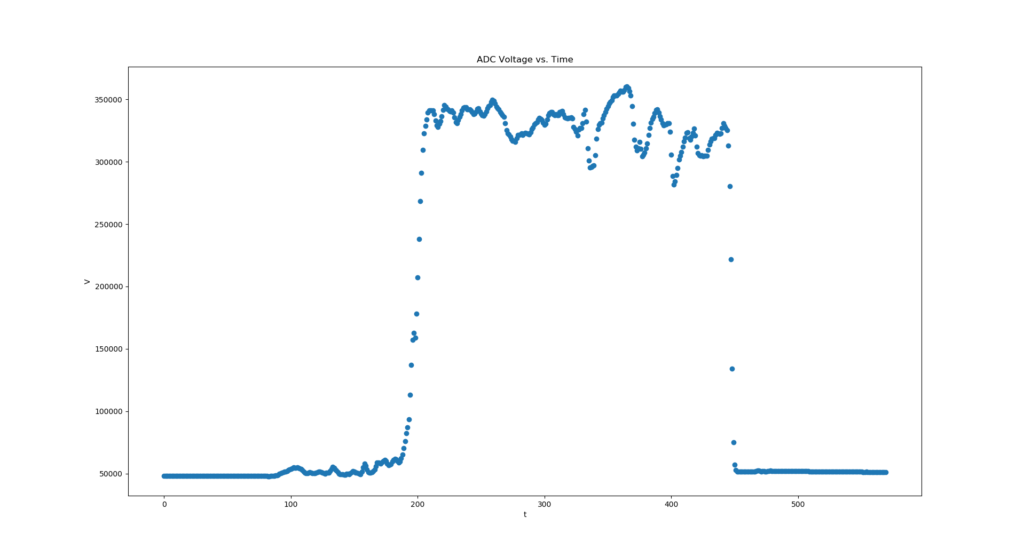
Gripping it as hard as I can. Was interesting to see grip strength fail and then increase again when I redoubled my efforts.
Seems to be a working, if low quality dynamometer. If I was to redo this I would build more around the grip and possible use different strain sensors. I might measure the effects of irraditation (tensing other muscles in this context) on grip strength later.
Grip strength can be used as a measure of overtraining.
There are ADC + strain gauge meters on ebay for hobby bodyweight scales (HX711) that should be good for measuring up to around 200kgs. I ordered one and plan to put the gauges between a pair of half cylinders of wood to measure grip strength.
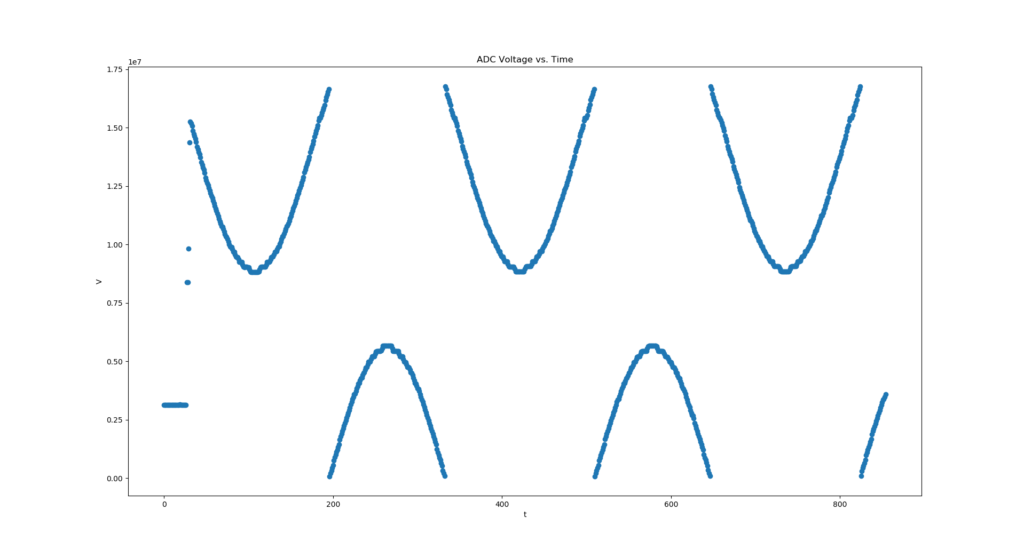
The HX711 can communicate with microcontrollers with a 2 wire interface like I2C. I’ve gotten this working with the Nucleo and tested it by having the Nucleo output a sin wave and reading the voltage that the HX711 measured.
project stuff here, remember that all the Nucleo stuff is compiled using the mbed compiler
Voltage measured by the HX711. Output is in two’s complement, which is why the sin wave is split between top and bottom. You can see the quantization in the DACs output because there’s a minimum 64 fold amplification for the HX711. This means that even a tiny voltage swing will saturate the output.
Two biofeedback sensors I can probably get working faster than the EEG are hand temperature and galvinic skin response. Hand temperature biofeedback is mostly used to train relaxation. Adrenaline restricts bloodflow to the skin and hands, so by training yourself to warm your hands you can learn to reduce adrenaline levels. Galvinic skin response is similar. People sweat more when nervous, filling sweat ducts with sweat. This is most pronounced on the hands and feet. Sweating reduces skin resistance by providing a conductive channel into the skin. This effect happens in seconds, and is used in polygraphs to detect lies.
For the most part, the resistance inside the body is low enough not to matter when measuring galvinic skin response. The simplest way to measure skin resistance is to put a current through two electrodes in contact with the skin and measure the voltage difference. This is usually done with electrodes on the index and ring fingers.
(For much more detail on measuring galvinic skin response, see Electrodermal Activity by Wolfram Boucsein)
While high temperature measurements usually use thermocouples, the easiest way to measure hand temperature is by using thermistors. The thermistors linked go between about 80k-100k Ohms around 70-100F. They are incredibly small, which gives them really fast response times and makes it easy to keep them around skin temperature.
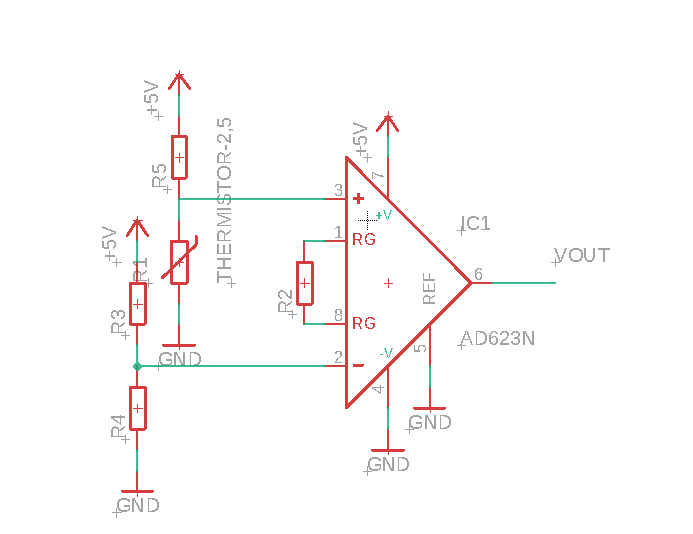
For measuring each of these resistances, I constructed voltage bridges with instrumentation amplifiers to increase the voltage range. I then used the integrated ADCs in the Nucleo microcontroller I have to measure the voltage.
Set up the voltage bridge with R3/R4 to be a bit below the lowest voltage between R1/R5. Select gain resistor so that Vout is below 3.3V when R1 at its highest. This setup can be used with both GSR and hand temp, but will require different resistors. GSR would probably benefit with variable resistors to set gain and comparison voltage.
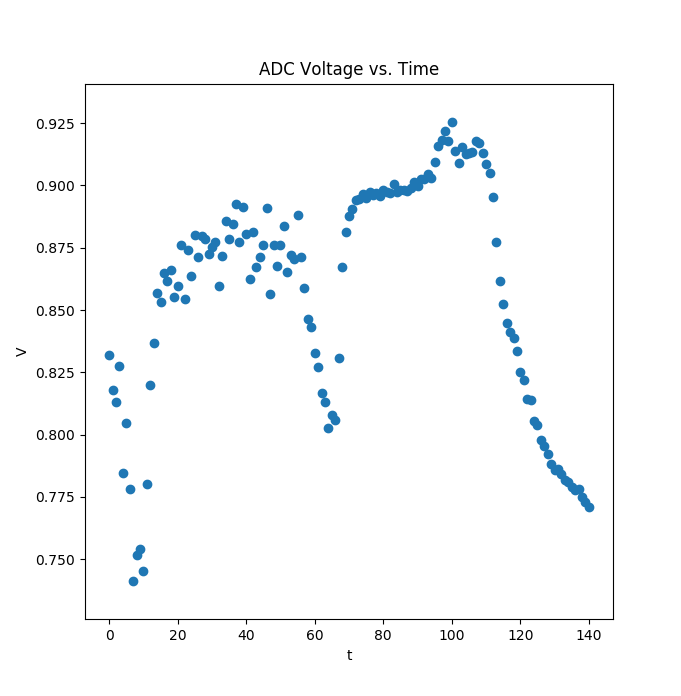
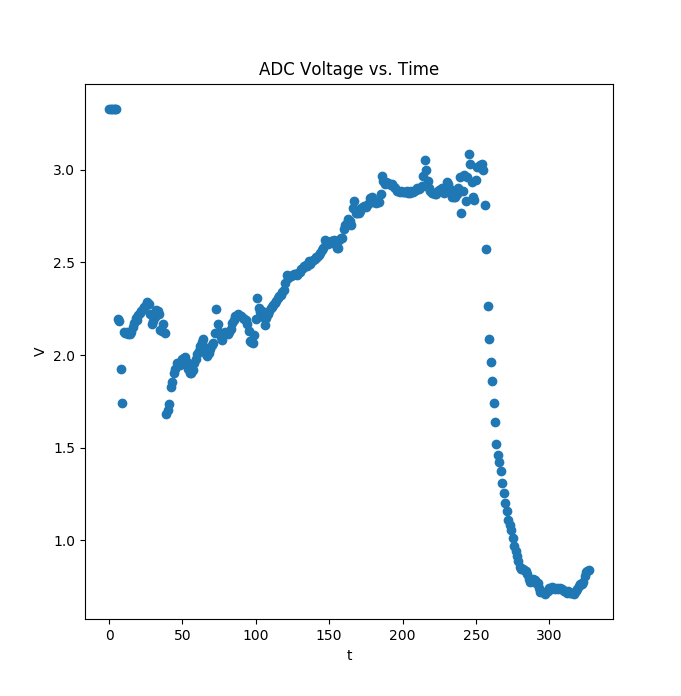
Plot of voltage measured for thermistor as I grabbed an icepack at t=50 and t=110.Voltage for skin resistance, again grabbing an icepack at T=220
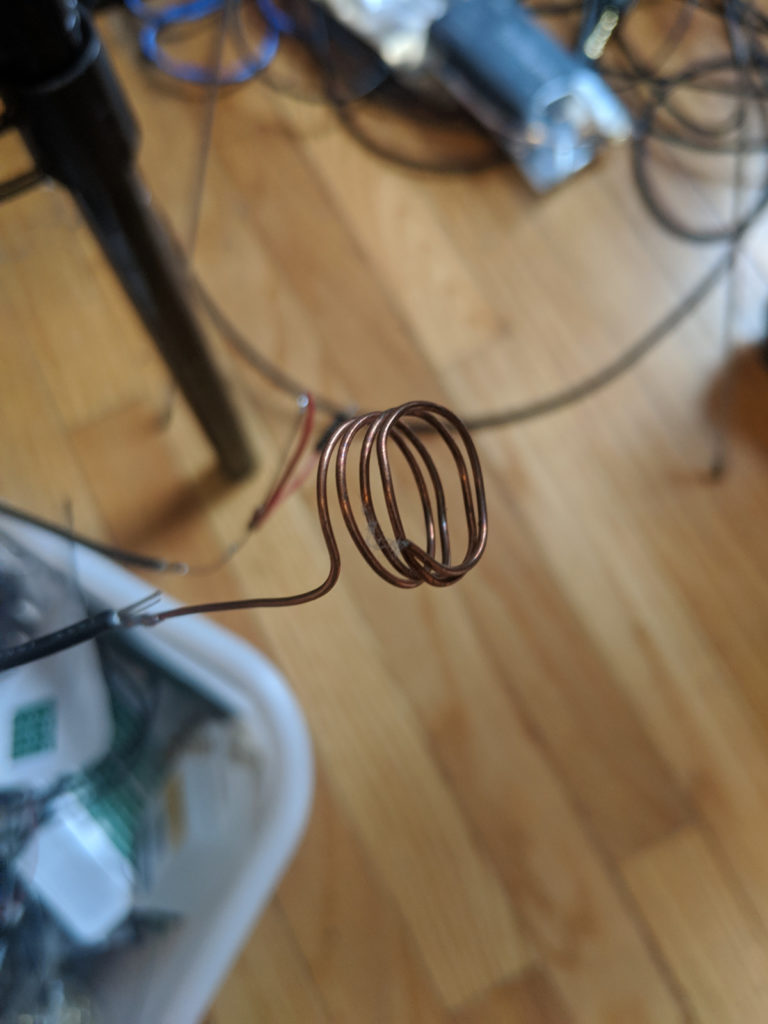
Like the EEG project, actually having a wearable probe is difficult. For GSR, I used the following copper coils:
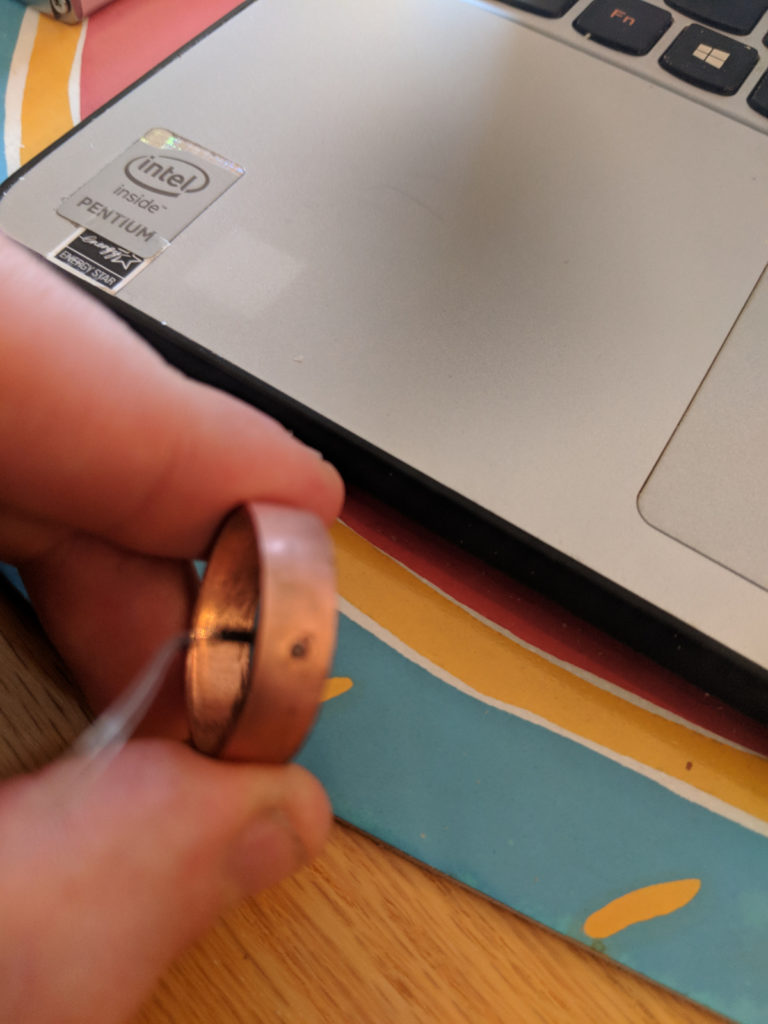
I also tried mounting the thermistors in sections of pipe which I could use as GSR electrodes. While it looks neat, I think it will require rings which fit better.
Starting with a fringe health thing that sort of works–light alarm clocks. I’ll probably post more on light later. I think I actually got seasonal affective disorder unrelated to the seasons by being a shut-in. In short, blue light suppresses melatonin production and probably wakes you up in other ways so it’s good to have some in the mornings. There are alarm clocks meant to wake you up this way, but I ended up making my own because I have some decently high powered LEDs lying around.
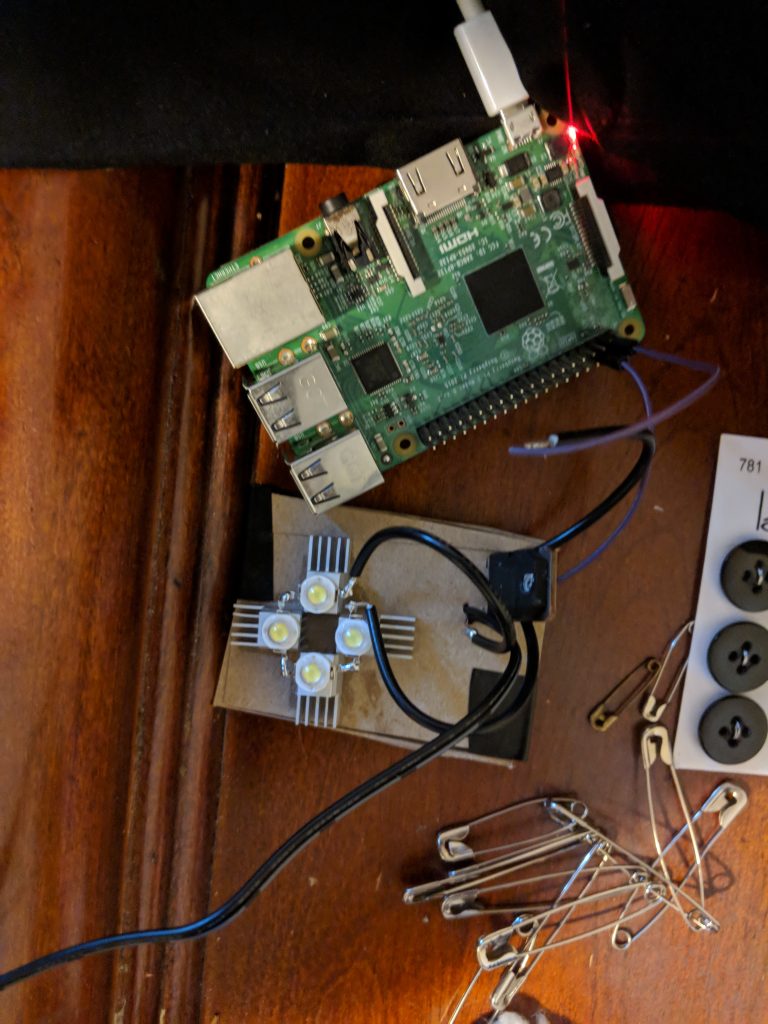
Say hello to my little firehazard
I did this about a year ago, so I don’t remember what the LEDs actually are. They are probably 3-5W, Chinese ones from Ebay, and all hooked up in series to a cannibalized 15W wallwart power supply with a power MOSFET that I got from a broken computer power supply as a switch. The voltage drop of the combined LEDs was just about perfect for the power supply. I had those little heatsinks lying around but they probably aren’t nessesary. This is about as bright as a normal 60W incandescent bulb when at full power. I control the brightness using PWM with a raspberry pi. See the program here (https://github.com/garthwhelan/light-alarm-clock), with instructions for use in the comments.
To tell the truth, I don’t use this any more. Even the tiny amount of light that gets past my blackout blinds signals daytime if I’m ready to get up, and I’ll stay in bed if not. What has worked is using orange safety glasses before bed, to aid in melatonin production, and a lightbox upon waking up.